



Kelp
DeFi has solved a lot of things.
We can mint dollars on-chain, swap globally, borrow instantly, and route capital without banks.
But there’s one thing DeFi still mostly doesn’t do:
Fund real-world short-term credit demand at scale.
Not “RWA rewards” in the passive sense.
Not long-duration loans.
Not undercollateralized lending.
We mean the high-frequency, self-liquidating, massive credit that makes global payments work.
Kred is built to bridge that gap.
It connects DeFi stablecoin capital to real world credit demand, using a clean flow:
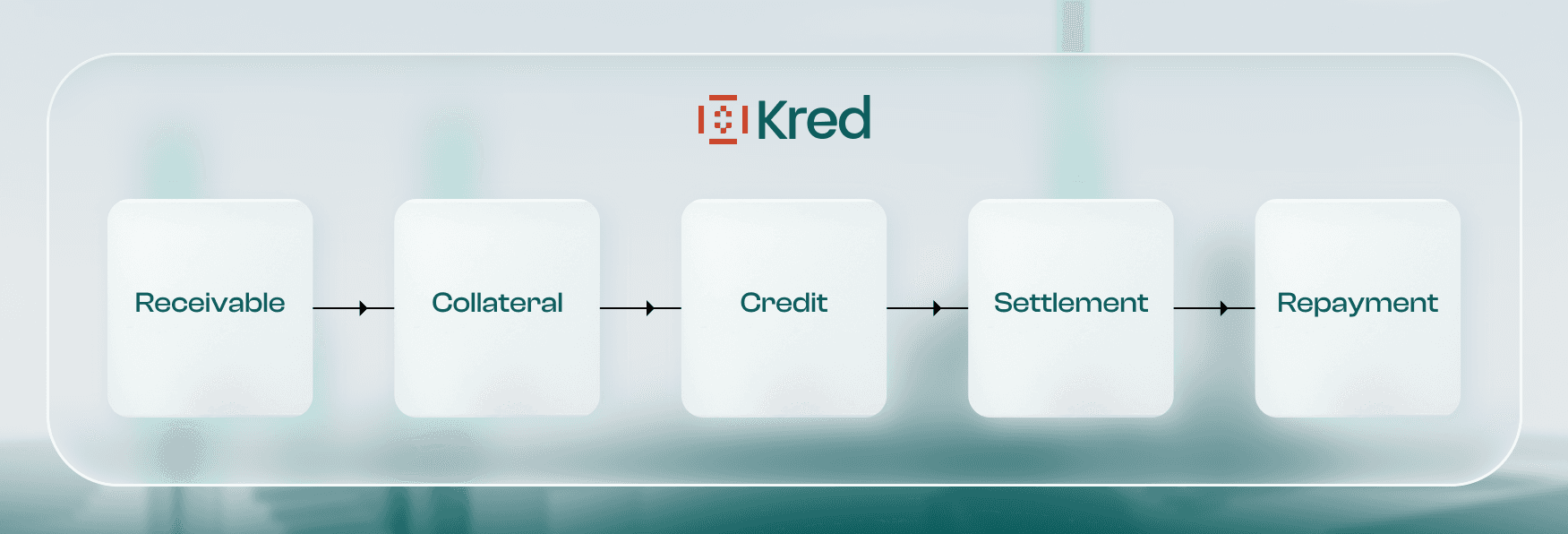
Receivable → Collateral → Credit → Settlement → Repayment
And it introduces a new primitive that DeFi doesn’t have today:
Internet of credit
Instant, secure Credit that exists because settlement is delayed and gets repaid when the settlement completes.
If you’ve ever wondered why $200T+ in annual payment flows still requires trillions of dollars parked as idle float, this is the missing layer.
Let’s break it down.
DeFi has Liquidity. No Destination.
DeFi has capital.
Stablecoin TVL is huge. Liquidity is deep.
But most of it ends up in one of two places:
Speculative loops (leverage, perp funding, basis trades)
Crypto-native lending (overcollateralized, vol-linked, reflexive)
Both are fine but structurally correlated to crypto markets.
Meanwhile, outside DeFi, global finance has the opposite problem:
settlement takes time
payments need liquidity immediately
so the system forces institutions to pre-fund and lock capital everywhere
This is why payment companies and remitters sit on giant idle balances.
Settlement is delayed and liquidity must be instant.
That’s the real liquidity gap.
And it’s massive.
PayFi needs: Credit against payment settlement receivables (short, fast-moving)
TradFi needs: Credit against commercial transaction receivables (longer, business operations)
What DeFi Has: Liquidity
What Kred Adds: The Bridge
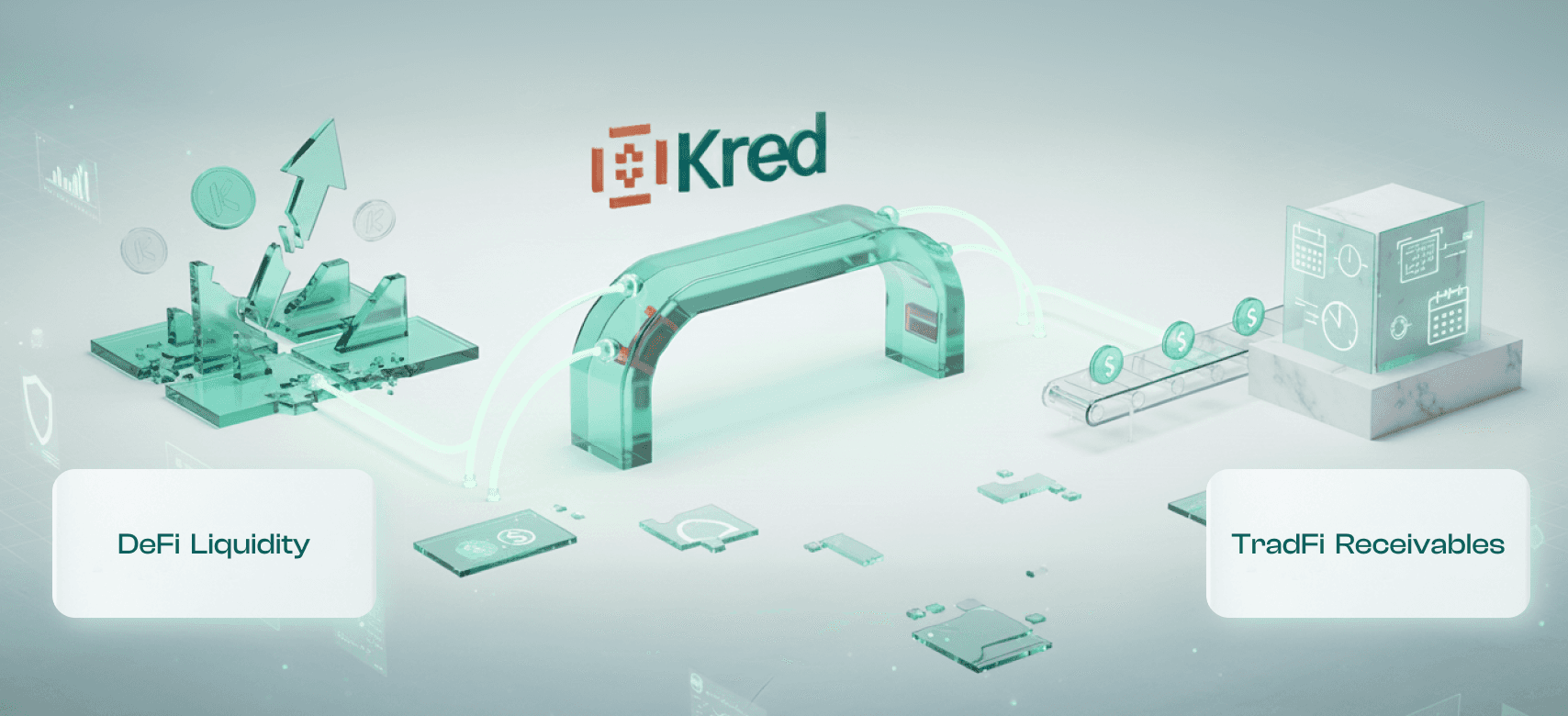
Kred serves two massive markets:
PayFi Credit (settlement-driven)
Payment processors waiting for card network settlement
Remittance companies bridging cross-border timing gaps
Treasury desks covering FX conversion delays
Duration: 1-7 days | Driver: Payment flows already in motion
TradFi Credit (transaction-driven)
Trade finance operators funding invoice cycles
Marketplaces managing vendor payout timing
Commerce platforms bridging purchase-to-settlement gaps
Duration: 7-90 days | Driver: Business operational needs
Both need the same thing: short-term, self-liquidating credit backed by real receivables.
Both create the same opportunity: predictable future payments that need liquidity now.
That's what Kred underwrites.
TradFi receivables become structured collateral
DeFi liquidity becomes just-in-time settlement credit
Repayment happens when settlement finalizes
The Kred Flow

1) Receivable
Borrowers are KYB-verified institutions (PSPs, remitters, marketplaces, treasury desks, trade finance operators, etc.).
They have a known pattern:
“We pay out now, we get settled later.”
That “settled later” is the receivable.
These aren’t degens borrowing against vibes.
They’re businesses with predictable transaction-backed flows.
2) Collateral
Kred doesn’t just “trust” receivables. It structures them into enforceable collateral:
borrower verification (KYB’d)
credit limits based on flow history
collateral terms & risk buffers
monitoring + repayment enforcement
This is a critical difference from generic “RWA rewards.”
Kred isn’t buying a long-duration asset.
It’s underwriting short-duration settlement credit.
3) Credit
DeFi LPs deposit stablecoins → mint KUSD.
That pool of stablecoins becomes the liquidity source.
Borrowers draw liquidity as credit — only when needed.
So instead of:
Locking capital in prefunded accounts
Maintaining dozens of corridor balances
Sitting on idle float
Borrowers get:
On-demand stablecoin liquidity
With transparent pricing and limits
Sourced from LP deposits
Where KUSD and sKUSD fit
KUSD is the on-chain representation of depositor capital + credit issuance
sKUSD is the staking layer for DeFi users who want to earn the repayment-driven rewards
LPs can hold KUSD, or stake it into sKUSD to earn rewards from borrower repayments.
4) Settlement → Powering real payment flows)
Borrowers use the stablecoin liquidity sourced from LP deposits to bridge real-world settlement obligations such as:
Merchant payouts
Remittance corridor payouts
Intraday FX liquidity needs
Payout platform obligations
Trade receivable cycles
So the core idea is:
DeFi stablecoins provide the liquidity upfront → Borrowers repay when payments settle → Liquidity gets recycled
This is what makes Kred the Internet of Credit: it exists because settlement is delayed, and it's consumed inside payment workflows.
5) Repayment → Rewards via sKUSD
The most important part:
Repayment is embedded in the same settlement cycle.
When card networks settle, invoices clear, or payout rails finalize, the receivable resolves.
That resolved settlement becomes repayment + interest.
This means credit is:
short duration
self-liquidating
high turnover
recycled repeatedly
How sKUSD generates rewards
Borrower repayments with interest are what generate rewards for sKUSD holders:
Borrowers repay principal + interest into the system
That interest is the real reward source
sKUSD represents staked KUSD earning these repayment cashflows
This packaging makes repayment-driven rewards composable inside DeFi
Kred the missing credit layer
If stablecoins were the breakthrough for transferring value, the next breakthrough is transferring liquidity where it's needed, when it's needed, under predictable rules.
That requires credit.
Kred bridges real-world credit demand with DeFi liquidity by:
Packaging receivables (from payments, settlements, and commerce) into enforceable collateral
Issuing on-demand credit matched to business cycles
Recycling DeFi stablecoin liquidity through real repayments
This isn't DeFi lending rebranded. It's not TradFi credit moved onto a blockchain.
It's a new primitive:
The Internet of Credit — where real-world receivables meet instant on-chain liquidity.
Sign up for more interesting blogs & updates