


Kelp
Let's be honest: for a while now, DeFi has felt a bit like a collection of walled gardens. If you wanted to launch a new market or support a specific asset class, you usually had to choose between fragmenting your liquidity or forcing your users into a one-size-fits-all risk pool. It worked, but it wasn't exactly efficient.
That changes today.
On March 30, 2026, Aave V4 officially went live on Ethereum mainnet. And because we're big believers in where this tech is headed, Kelp is right there at the starting line as a featured launch partner.
Kelp has a dedicated Spoke in the initial configuration with rsETH as collateral, and here is why that is a massive deal for you.
What's a "Spoke" anyway?
Think of Aave V4 as one deep liquidity pool (the Hub) connected to specialized markets (Spokes).
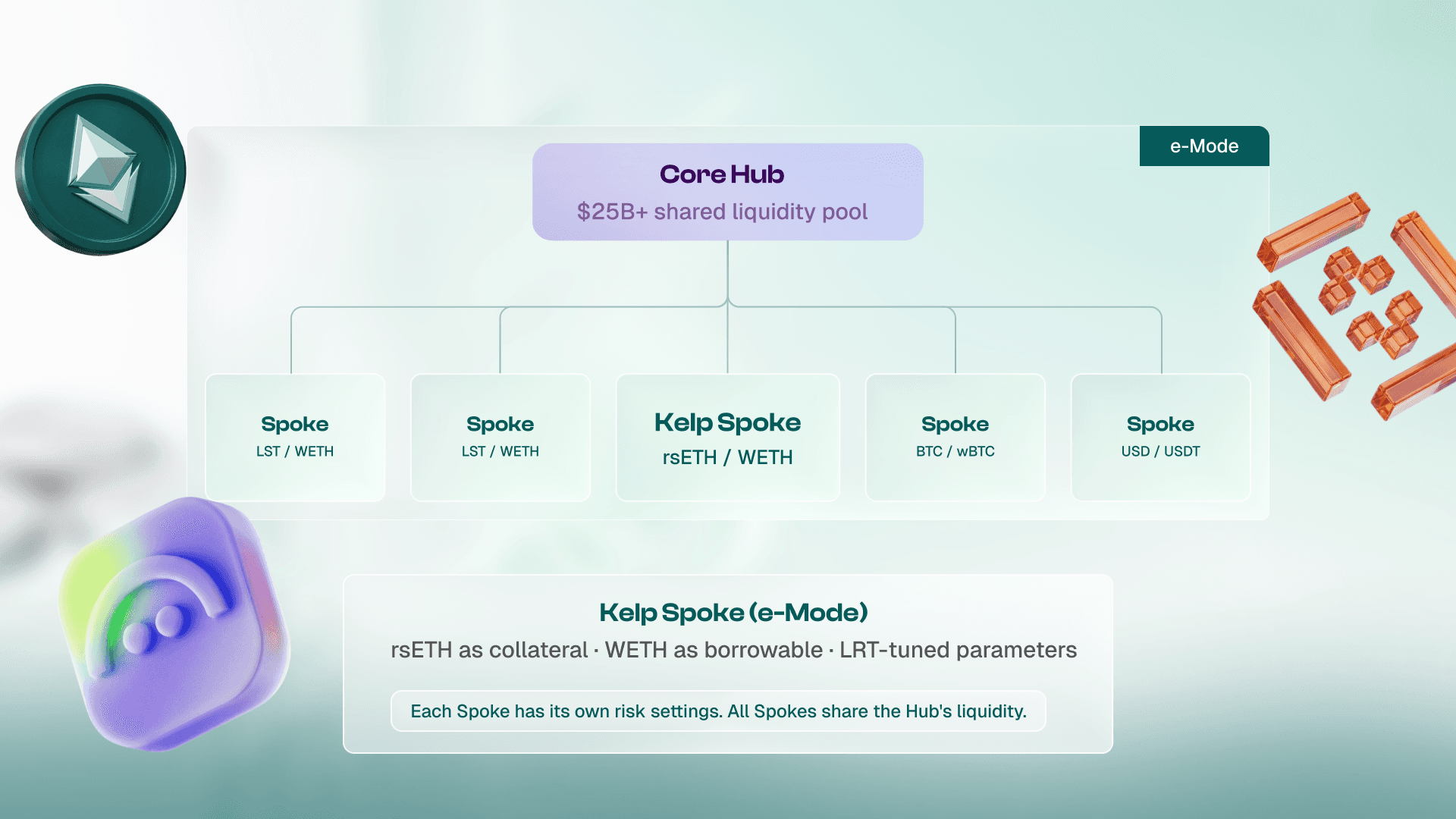
The Hub: A shared liquidity reservoir holding $25B+ in deposits.
The Kelp Spoke (e-Mode): A dedicated borrowing market for rsETH that plugs directly into that pool. rsETH as collateral, WETH as borrowable, with parameters tuned specifically for liquid restaking tokens.
On V3, rsETH sat in shared pools where risk settings were designed for the pool, not for rsETH. If we wanted a market that matched rsETH's actual risk profile, it would've meant an isolated pool with thin liquidity.
V4 removes that tradeoff.
The Kelp Spoke has its own risk parameters, its own liquidation logic, and its own e-Mode configuration, but it draws from the same deep liquidity backing every other V4 market.
rsETH has been one of the fastest-growing collateral assets across Aave's V3 markets. That track record is what a dedicated Spoke is built on. V4 finally gives it the infrastructure to match.
Why this matters for your assets
Better risk pricing. The Kelp Spoke's e-Mode recognizes the tight correlation between rsETH and WETH, which means higher LTV, tighter liquidation thresholds, and better capital efficiency than rsETH has ever had on Aave. Your borrowing costs reflect the actual risk of your collateral.
Safer liquidations. V4's liquidation engine only takes what's needed to restore a position to health, instead of the old approach where liquidators regularly took more than necessary.
345 days of security review. Four audit firms (ChainSecurity, Trail of Bits, Blackthorn, Certora), four independent researchers, a public contest on Sherlock with 900+ participants, and a $1.5M budget ratified by the Aave DAO.
Conservative at launch. Supply and borrow caps start tight. The Aave DAO will expand them as V4 matures under real conditions.
What you can do right now
Borrow WETH against rsETH. Deposit into the Kelp Spoke, borrow WETH. Your restaking rewards keep running.
Leveraged looping, more efficiently. Deposit rsETH, borrow WETH, swap back, deposit again. Tighter e-Mode settings on V4 mean more out of each loop than V3.
Composable supply positions. Your V4 deposit is tokenized in a format other protocols can build on directly. As more gets built on V4, your position becomes useful in more places without you touching it.
The bigger picture
DeFi lending is moving from pools to infrastructure. V4 can support collateral types that never worked in a shared pool model, from assets with non-standard redemption timelines to institutional credit structures. The architecture is built for what's coming, not just what exists today.
Kelp is proud to be part of this foundation.
This goes beyond an integration for us. We want to be part of shaping how onchain lending works from here.
rsETH is connected to V4 from day one. 50+ integrations, $1.4B+ TVL, 350K+ users, and now a dedicated market on the deepest lending liquidity in DeFi.
The age of unified liquidity is here. Let's get to work.
Sign up for more interesting blogs & updates