


Kelp
KUSD does not earn rewards because markets go up.
It earns rewards because payments settle.
Most on-chain rewards are tied to market conditions or incentives. KUSD rewards are tied to settlement activity so the right way to understand it is the loop below:
Institution draws credit line liquidity → Settles → Repays → Capital is reused
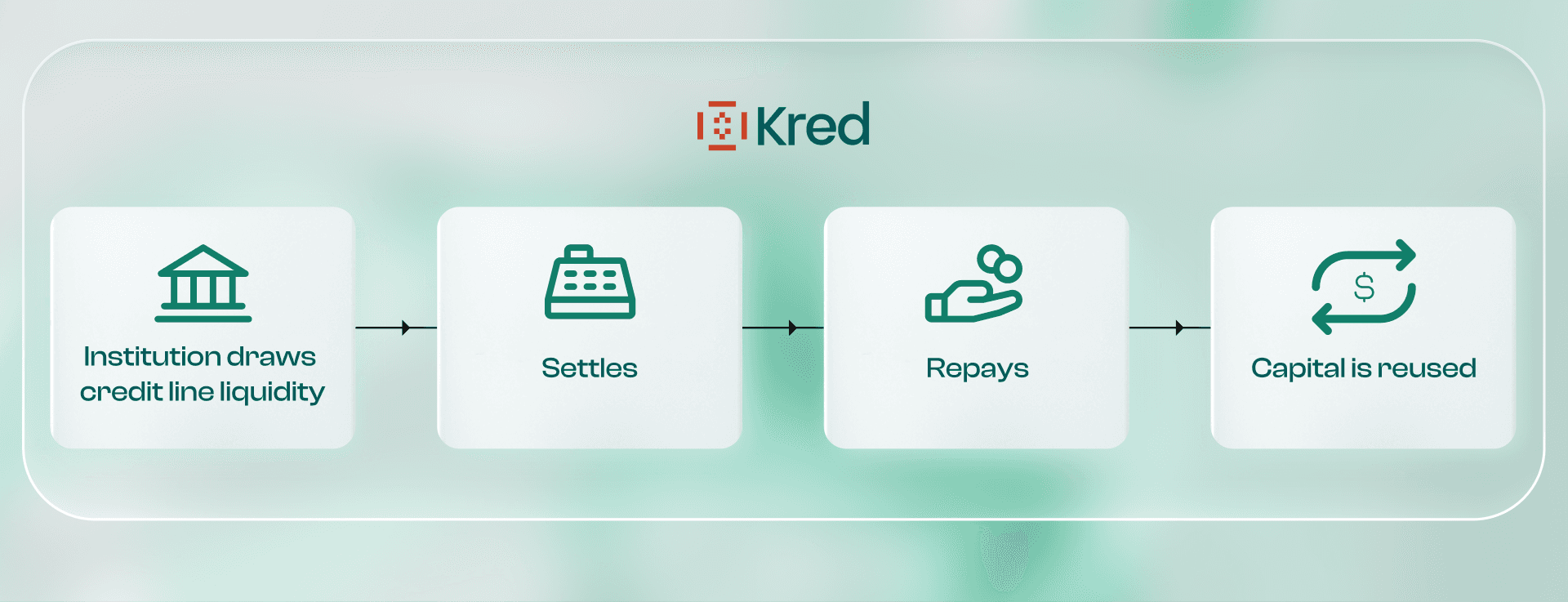
KUSD sits directly on top of this cycle and sKUSD is staked KUSD that earns automated rewards.
No leverage.
No emissions-driven incentives.
No speculative reflexivity.
Just short-term credit doing real work, repeatedly.
The Real Bottleneck in Global Payments
Modern finance looks instant, but settlement still runs on buffers and pre-funding. In 2023, the payments industry processed ~3.4T transactions worth ~$1.8 quadrillion.
Source - McKinsey & Company
Cross-border flows alone approached ~$1 quadrillion in 2024.
Pre-funding is mandatory: money gets parked before settlement happens.
Cross-border: more intermediaries + more delays = bigger buffers.
Result: massive liquidity sits idle simply to keep payments flowing.
Kred’s role is to replace “idle buffers” with on-demand settlement liquidity that can earn rewards.

Step 1: Liquidity Becomes KUSD
When liquidity providers deposit USDC or USDT, they receive KUSD as a 1:1 receipt token representing their claim on the underlying capital.
At this stage, the capital characteristics change fundamentally:
• It is no longer exposed to crypto market price movements
• It is no longer speculating on market direction
• It is allocated for deployment into short-term settlement credit
KUSD represents a claim on capital that will be continuously deployed into real payment flows. The underlying stablecoins don’t sit idle—they’re ready to be matched with verified businesses needing settlement liquidity.
Step 2: KUSD Becomes sKUSD (The Rewards Layer)
KUSD can be staked into sKUSD, which is where the rewards mechanism activates.
sKUSD serves two functions:
1. Rewards accrual: As deployed liquidity is repaid through settlement cycles, the interest earned flows to sKUSD holders
2. DeFi composability: sKUSD is an ERC-20 token that can be used across DeFi protocols while still earning from underlying credit activity
The separation between KUSD (receipt) and sKUSD (rewards-earning) creates a flexible structure: KUSD remains liquid and transferable, while sKUSD captures the economic value generated by the credit infrastructure.
Step 3: A Payment Business Draws Liquidity
KYB-verified institutions like PSPs, remitters, FX desks, marketplaces, draw liquidity when they need to settle transactions.
Key characteristics:
Drawn only when required
Used for minutes, hours, or days
Bound by transparent credit limits and terms
Think of it as just-in-time settlement liquidity: drawn when needed, repaid as transactions settle.
Step 4: Real Transactions Settle
Once deployed, that liquidity enables:
Customer payouts
Cross-border transfers
FX conversions
Invoice and trade settlements
This is where value is actually created.
Rewards are generated by transaction completion and settlement.
As payments settle:
Fees are earned
Receivables clear
Cash flows resolve
The credit is self-liquidating.
Step 5: Borrowers Repay → sKUSD Earns Rewards
As settlements complete, borrowers repay:
Principal
Plus a predefined interest rate
Those rewards flow directly to sKUSD holders.
There’s no dependency on:
Market sentiment
Token appreciation
Continuous refinancing
Repayment is driven by settlement finality, not speculation.
Step 6: The Same Capital Is Reused
This is the compounding engine behind sKUSD.
Once repaid:
Capital is immediately available again
It can fund the next settlement cycle
Often multiple times per week
This liquidity can support many real-world transactions per year.
Rewards are generated by capital velocity, not long lockups.
Why sKUSD Is Not a Speculative Rewards Product

sKUSD does not rely on:
Emissions
Leverage
Liquidity mining
Market reflexivity
If payment volume exists, rewards exist.
If settlements happen, value accrues.
The system scales with:
Global payment flows
Cross-border commerce
Trade and settlement velocity
Not with crypto market cycles.
KUSD = High Rewards-bearing Stablecoin
sKUSD = Settlement-Native Rewards
sKUSD is best understood as settlement-native rewards, not DeFi rewards generating from real-world financial activities.
It replaces:
Idle pre-funded accounts
Nostro buffers
Expensive short-term bank credit
With:
On-demand liquidity
Transparent on-chain rules
Short-duration, self-liquidating exposure
For liquidity providers, this means:
Capital is always working
Rewards come from real economic activity
Risk is tied to duration and settlement. Not speculation
The Core Insight
KUSD earns from within the payment loop through sKUSD
Capital → enables settlement → gets repaid → gets reused
Over and over again.
That’s where the rewards come from. That’s why they’re durable.
Sign up for more interesting blogs & updates